
If you have clicked on this article, chances are you are confused about the difference between the Eisenhower Matrix and the Covey Matrix. These two frameworks look almost identical because Covey adapted his matrix from Eisenhower’s original idea.
Both use a 2×2 grid, separate urgent tasks from important tasks, and promise to help you prioritise and manage time effectively. So what is the actual difference, and does it even matter?
This article will clear up the confusion by exploring where each matrix came from, how they differ in practice, and which one might work best for your situation.
Let’s start by looking at where these frameworks originated, because understanding their roots explains why they evolved in different directions.
What is the Eisenhower Matrix?
The Eisenhower Matrix traces back to President Dwight D. Eisenhower, the 34th President of the United States and former World War II general. Eisenhower was famous for his ability to sustain productivity over decades of military and political leadership.
Eisenhower is famously associated with the insight that there are two kinds of problems: the urgent and the important. The urgent are not important, and the important are never urgent.
This simple observation became the foundation for what we now call the Eisenhower Matrix.
The Four Quadrants Explained
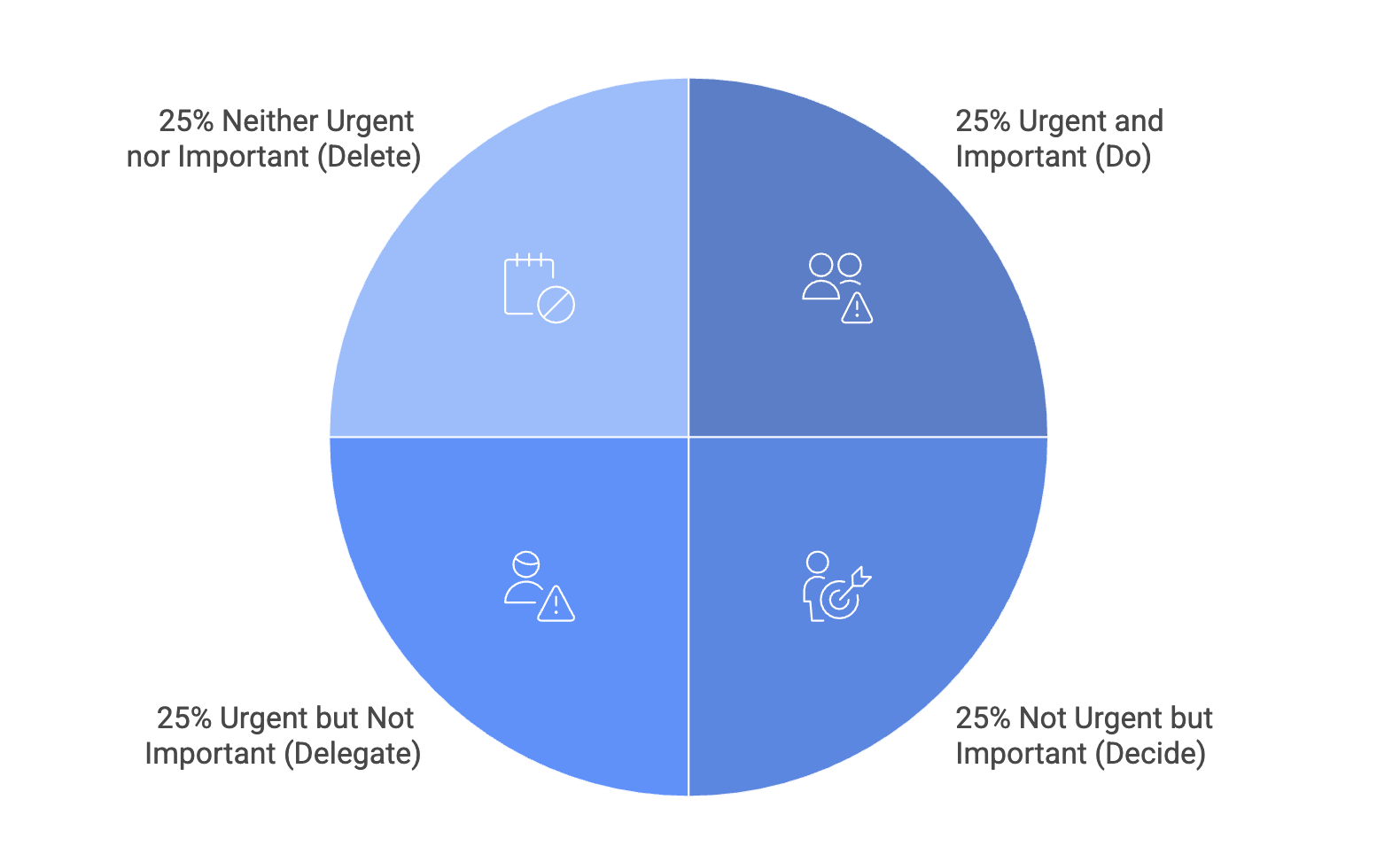 The Eisenhower Matrix divides all your tasks into four quadrants based on two criteria: urgency and importance.
Quadrant 1: Urgent and Important (Do)
These are crisis situations, pressing deadlines, and emergencies that demand immediate attention. A server crash at work or a client complaint that needs to be resolved today. These urgent and important tasks cannot wait.
Quadrant 2: Not Urgent but Important (Decide)
This is where strategic thinking happens. Long-term success depends on Quadrant 2 work, including planning, relationship-building, and skill development. These important tasks never feel urgent, but they are what actually shape your future.
Quadrant 3: Urgent but Not Important (Delegate)
These are interruptions and distractions that feel pressing but do not move you toward your goals. Many phone calls, some emails, and other people’s priorities fall into this category. The Eisenhower Matrix suggests you delegate these tasks whenever possible.
Quadrant 4: Neither Urgent nor Important (Delete)
Time wasters like mindless scrolling and unnecessary meetings that neither require immediate action nor contribute to your objectives. The Eisenhower Matrix recommends eliminating these altogether.
Core Philosophy: Separating Urgency from Importance
The Eisenhower decision matrix is based on a fundamental principle: urgency and importance are not the same. Urgent matters demand immediate attention, whereas important matters contribute to your long-term goals and values.
The framework gives you four clear actions: Do, Decide, Delegate, and Delete. This action-oriented language makes decision-making quick and straightforward, which is exactly what Eisenhower needed in his high-pressure roles.
The Eisenhower Matrix works particularly well for executives, operations managers, and anyone facing high-volume decision environments. It excels in crisis-prone industries where you need to make rapid calls about what deserves your attention.
What is the Covey Matrix?
Stephen Covey took Eisenhower’s concept and transformed it into something broader. In his bestselling book “The 7 Habits of Highly Effective People,” Covey introduced what he called the time management matrix.
Covey did not just rename the quadrants. He reframed the entire philosophy around personal effectiveness and leadership development rather than tactical decision-making.
The Four Quadrants with Covey’s Terminology
The Covey matrix uses the same urgent-important structure, but Covey described each quadrant differently to emphasise their psychological impact.
Quadrant 1: Crisis and Deadline-Driven
Covey called this the quadrant of necessity. These are genuine emergencies, urgent crises, and pressing problems. Covey warned that living here constantly leads to stress and burnout.
Quadrant 2: Proactive and Strategic
This is where Covey placed his emphasis. He called Quadrant 2 the quadrant of quality and personal leadership. This is where you find prevention, planning, relationship building, and personal development. Covey argued that highly effective people spend most of their time in important Quadrant 2 activities. This prevents future emergencies and reduces the time you spend in crisis mode.
Quadrant 3: Interruptions and Distractions
Covey described this as the quadrant of deception. These tasks feel urgent, but they are not aligned with your goals. They are often other people’s priorities masquerading as your own.
Quadrant 4: Time Wasters
Covey called this the quadrant of waste. Activities here are neither urgent nor important. Excessive TV, mindless internet browsing, or trivial busywork.
Connection to Put First Things First
The Covey time management matrix is not a standalone tool. It is the practical application of Habit 3 from the 7 Habits framework: Put First Things First.
Covey tied the matrix to his broader philosophy of personal and professional effectiveness. Using the matrix means aligning your daily actions with your deepest values and long-term vision.
Living in Quadrant 2
While Eisenhower’s matrix helps you categorise and act, the Covey matrix emphasises a way of living. Covey’s central message was that you should deliberately structure your life to maximise time spent on important but not urgent activities.
This means saying no to Quadrant 3 distractions, scheduling important Quadrant 2 time blocks before they become Quadrant 1 emergencies, building relationships before you need favours, and maintaining your health before you face a crisis.
What Are The Main Differences Between the Eisenhower and Covey Matrices?
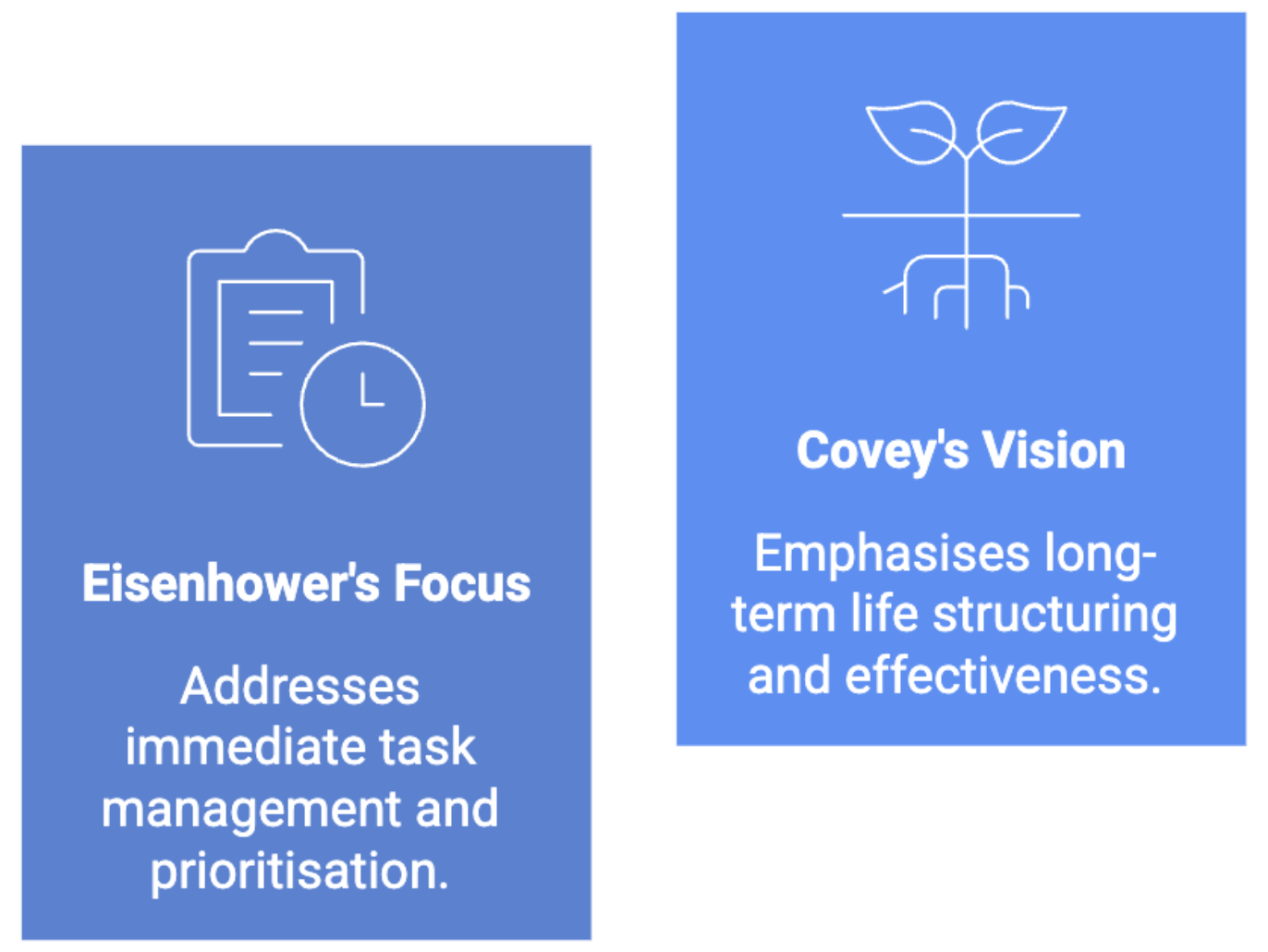 Now we get to the heart of the matter. Both matrices use four quadrants based on urgency and importance. So what actually separates them?
Philosophical Differences
The Eisenhower Matrix emerged from a military and political context. Eisenhower needed a system for rapid decision-making under pressure, so his framework is tactical and situational.
The Covey Matrix grew from leadership development and personal effectiveness work. Covey taught people how to live more fulfilling lives and become better leaders, so his framework is both strategic and holistic.
Eisenhower asks: “What should I do with this task right now?” Covey asks: “How should I structure my life for long-term effectiveness?”
This changes how you apply each matrix day to day. Eisenhower’s approach is reactive in nature, even as it tries to create space for important work. Covey’s approach is proactive from the start, built around prevention and planning.
Terminology and Language
The quadrant naming conventions reveal different priorities.
The Eisenhower Matrix uses descriptive, action-oriented labels. Quadrant 1 tasks are simply “Urgent and Important.”
The Covey Matrix uses interpretive labels that carry psychological weight. “Crisis and Deadline-Driven.” “The Quadrant of Quality.” “Deception.” These names teach you how to think about each quadrant, not just how to act on tasks based on urgency.
Eisenhower’s language speeds up decision-making, whereas Covey’s language encourages reflection about whether you are investing enough in quality activities.
Practical Application
The Eisenhower Matrix works on a task-by-task basis. You review your to-do list, classify tasks by urgency and importance, and take appropriate action. It is a daily sorting mechanism.
The Covey time management matrix works at a higher level. You are meant to design your entire schedule around Quadrant 2 activities. Covey recommended blocking out time for important but not urgent work first, then fitting other commitments around that foundation.
With Eisenhower, you manage tasks. With Covey, you manage your life and energy according to a philosophy.
Time Allocation Philosophy
Both frameworks emphasise the importance of Quadrant 2. But they approach time spent differently.
The Eisenhower Matrix helps you identify which tasks deserve your focus and which should be delegated or deleted. The focus is on reducing time in Quadrants 3 and 4, so you have more capacity for important work.
The Covey Matrix prescribes how much time you should aim for in each quadrant. Covey argued that effective people spend 65 to 80% of their time in Quadrant 2. The time you invest in Quadrant 2 today reduces the time you spend in Quadrant 1 tomorrow.
Target User
The Eisenhower Matrix serves executives, decision makers, and anyone in high-pressure roles where priorities shift rapidly. The Covey Matrix serves leaders focused on long-term effectiveness and work-life balance.
If you are drowning in immediate demands, start with Eisenhower. If you are looking to transform how you approach your entire professional and personal life, Covey offers more depth.
Flexibility
The Eisenhower Matrix is more rigid in its categorisation. A task is either urgent or not, important or not. You sort it, you act on it, you move on.
The Covey Matrix acknowledges that priorities shift over time and context matters. Covey built his matrix into a larger framework about defining your mission and values first, then aligning your time accordingly.
Comparison Table: Side-by-Side Breakdown
| Aspect | Eisenhower Matrix | Covey Matrix |
| Origin | Military and political decision making | Personal effectiveness and leadership development |
| Primary Focus | Task categorisation and rapid decisions | Life structure and proactive living |
| Quadrant 2 Emphasis | Important work when possible | 65 to 80% of time should be spent here |
| Language Style | Action verbs (Do, Decide, Delegate, Delete) | Psychological descriptors (Crisis, Quality, Deception) |
| Application Level | Daily task management | Holistic life and time management framework |
| Best For | High-pressure tactical environments | Strategic planning and personal transformation |
| Flexibility | More rigid categorisation | More fluid with emphasis on prevention |
Benefits of the Eisenhower Matrix
The Eisenhower Matrix offers distinct advantages for fast-paced work environments.
The biggest benefit is simplicity. You can start using the Eisenhower Matrix in about five minutes. Draw four boxes, label them, and start sorting tasks. This makes the framework accessible to entire teams without lengthy training.
The clear action verbs (Do, Decide, Delegate, Delete) eliminate ambiguity. Once you have categorised a task, you know exactly what to do with it. This clarity accelerates decision-making when you are facing pressing deadlines and urgent crises that require immediate attention.
The Eisenhower Matrix also shines as a daily time management and planning tool. Each morning, you can review your tasks, classify them into quadrants, and structure your day. It helps you prioritise tasks effectively without getting lost in philosophical questions.
The Eisenhower Matrix is particularly effective for:
- High volumes of incoming tasks that need rapid sorting
- Situations with clear criteria for what counts as important and urgent tasks
- Work environments where delegation is readily available
- Customer service teams handling urgent crises
- Operations managers coordinating multiple priorities
- Crisis response teams that need to maintain focus under pressure
Benefits of the Covey Matrix
The Covey Matrix offers different strengths, particularly for leaders focused on long-term transformation.
The biggest advantage is that the Covey Matrix goes deeper than just task sorting. It is part of a complete personal effectiveness system built on decades of leadership research. This means you are not just learning what to do with your time, you are learning why certain activities matter more than others.
Covey’s real breakthrough was his obsession with Quadrant 2. When you schedule these activities first, you prevent most future emergencies.
This shift from crisis management to prevention changes everything. Leaders using Covey’s approach invest in activities that build over time. They have stronger teams because they make time for relationships. They face fewer fires because they planned ahead.
The Covey Matrix particularly shines for:
- Leaders transitioning from reactive to proactive work patterns
- Organisations building or transforming culture
- Long-term strategic planning initiatives
- Executives addressing personal values and organisational vision
- Teams trying to break the constant firefighting cycle
- Anyone seeking personal and professional growth alongside productivity
Which Matrix Should You Use?
So, which time management matrix is right for you? The honest answer is that it depends on your context, role, and what you are trying to achieve.
| Use the Eisenhower Matrix if you are: | Use the Covey Matrix if you are: |
| Operations managers making dozens of decisions daily | Leaders focused on long-term effectiveness |
| Working in high-volume decision environments | Working on personal development |
| Prioritising daily tasks for yourself or your team | Building proactive organisational cultures |
| Leading teams that need quick priority alignment | Engaged in strategic planning |
| Managing crisis-prone industries or departments | Transitioning your team from reactive to proactive work |
Combining Both Approaches
The thing is, you do not have to choose exclusively. Many professionals find value in combining elements of both approaches.
You can use the Eisenhower Matrix for daily tactics. Each morning, review your tasks and categorise them using the four quadrants. And you can utilise the Covey Matrix for strategic thinking. During weekly or monthly planning sessions, step back and assess whether you are spending enough time in Quadrant 2.
This combined approach gives you tactical clarity for day-to-day management while maintaining a strategic focus on what matters most over time.
How to Implement Your Chosen Matrix
Knowing about these frameworks is useful, but actually using them is what drives results.
Getting Started
Start with a simple four-quadrant grid on paper, in a spreadsheet, or using a digital tool. Take your current to-do list and honestly categorise where you are spending your time. This audit reveals your starting point.
Set aside time each week to review how you are using the matrix. Are you spending enough time on important but not urgent activities?
Best Practices
Be honest about the difference between true and perceived urgency. Not everything that feels urgent actually is urgent. Challenge yourself to distinguish between genuine deadlines and manufactured pressure.
Schedule Quadrant 2 time blocks before other commitments fill your calendar. Treat these as non-negotiable appointments with yourself for planning, strategic thinking, and relationship building.
Where People Go Wrong
The most common mistakes are treating everything as a crisis (if everything is urgent and important, nothing is), letting Quadrant 2 work slide until it becomes an emergency, and refusing to delegate tasks that someone else could easily handle.
Priority Management’s Approach
At Priority Management, we have been helping professionals and organisations master priority systems for over 40 years. Our training goes beyond just teaching matrix frameworks. We help you understand your unique productivity patterns, identify your specific time drains, and develop customised systems that work with your natural rhythms. The goal is not perfect adherence to a system but sustainable improvement in how you manage your energy and focus.
Finding Your Priority System
The Eisenhower Matrix and Covey Matrix are not competing systems. There are two stages in the evolution of the same core idea.
Eisenhower gave us the breakthrough insight that urgency and importance are different, and that confusing them leads to poor decisions. His matrix became a tactical tool for rapid decision-making under pressure.
Covey took that same insight and expanded it into a complete philosophy. He shifted the focus from sorting tasks to designing your life around prevention, proactive work, and long-term values.
So which one should you use? It depends on what you need right now. If you are drowning in daily demands and need quick clarity, the Eisenhower Matrix gives you immediate traction. If you are stuck in reactive patterns and want to transform how you work, the Covey Matrix offers the depth to make that shift.
Most professionals get the best results by using both. Apply Eisenhower’s simplicity to your daily workflow. Apply Covey’s Quadrant 2 philosophy to your weekly and monthly planning.
The real power is not in picking the “right” framework, it is in consistently applying priority management principles to reduce time wasted on urgency and distraction and increase time spent on what truly matters.
If you want to go deeper into priority management techniques that work in real Australian workplaces, Priority Management can help. Visit our website to learn more about our courses or give us a call.
FAQs
What is the difference between the Covey Matrix and the Eisenhower Matrix?
The key difference is scope. Eisenhower created a decision-making tool for sorting individual tasks throughout your day. Covey transformed it into a life design system focused on how you allocate your entire week. If you need help deciding what to work on right now, use Eisenhower. If you want to restructure how you spend your time overall, use Covey.
What are the benefits of the Eisenhower Matrix?
The Eisenhower Matrix gives you clarity when you are overwhelmed. Instead of staring at a massive to-do list, wondering where to start, you can sort everything in minutes and know exactly which tasks to tackle first, which to schedule for later, which to hand off, and which to ignore completely. That immediate clarity is why it works so well for busy managers juggling multiple priorities.
What is the difference between the Eisenhower Matrix and the Priority Matrix?
“Priority Matrix” is a generic term that often refers to the Eisenhower Matrix, though some software companies use it as a product name for digital task management tools. If someone mentions a Priority Matrix, they are usually referring to the same urgent-versus-important framework that Eisenhower developed. The underlying concept is identical.
How does the Eisenhower Matrix help leaders distinguish between urgent and important tasks in a high-pressure environment?
The matrix forces you to ask one critical question: “If I ignore this task, what actually happens?” That question cuts through the noise. Many things feel like urgent tasks because someone is pushing for them, not because they genuinely matter to your goals. The visual quadrant structure helps you avoid reactive decisions based solely on who is shouting the loudest and focus on what will actually move your business forward.