Situational leadership means adapting your management style to the person in front of you.
Picture two people on the same team. One joined six weeks ago and is still learning the ropes. The other has been with the business for nearly a decade. If a leader manages both people the same way, they will get it wrong for at least one of them.
Situational leadership is the management approach that addresses this directly. It is a flexible management style built on one idea: effective leaders do not rely on a single fixed leadership style. They read where each person is and adjust accordingly. Understanding what situational leadership looks like in practice is what separates leaders who adapt well from those who do not.
What Is the Situational Leadership Model?
The situational leadership model was developed by Dr Paul Hersey and Dr Ken Blanchard in 1969, published in their textbook Management of Organizational Behaviour (originally called the Life Cycle Theory of Leadership, renamed in the mid-1970s). Ken Blanchard later introduced SLII as a slightly different version, but the situational leadership theory at its core remained unchanged.
The core principle of the situational leadership model is that there is no single best leadership style. The leadership styles described by Hersey and Blanchard in Management of Organizational Behaviour continue to inform how leaders are trained worldwide. The most successful leaders adapt based on the performance readiness of individual team members.
The Four Situational Leadership Styles
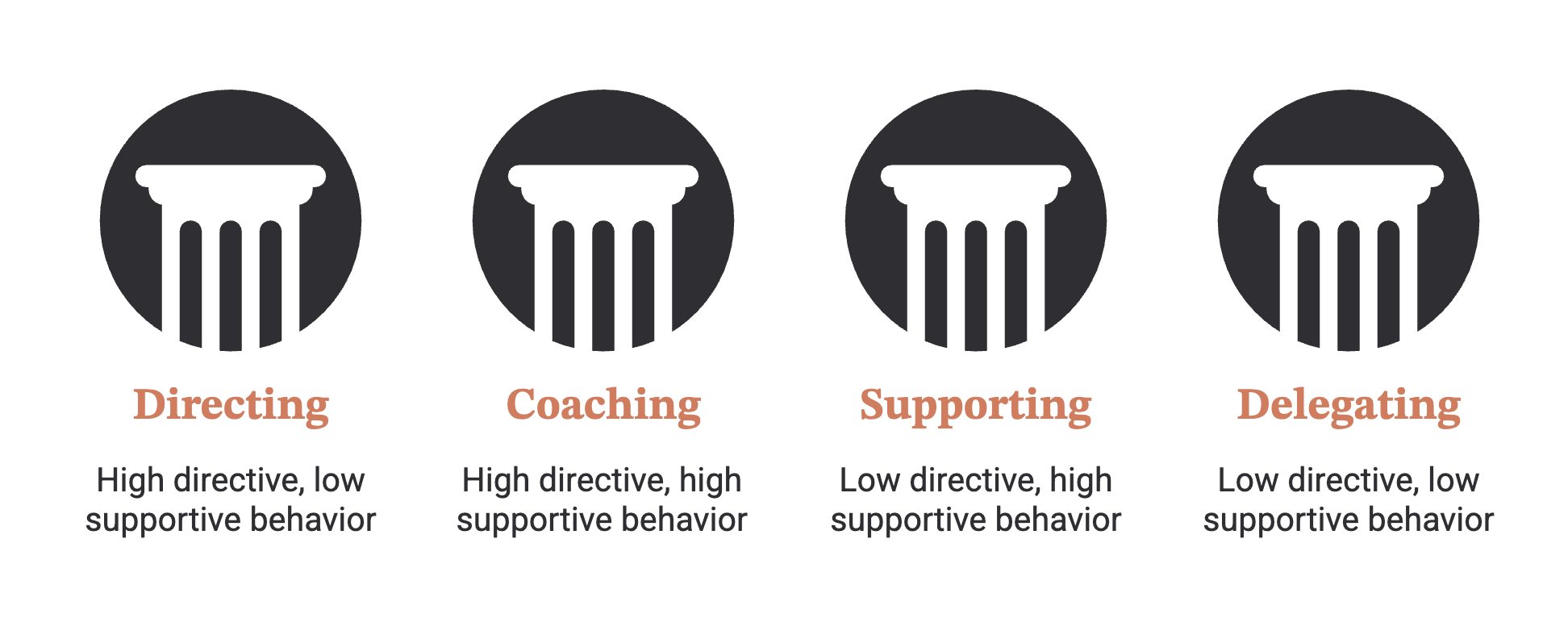
The situational leadership model identifies four leadership styles, S1 through S4. In the original framework from Management of Organizational Behaviour, these were labelled Telling, Selling, Participating, and Delegating. Current practitioner use favours Directing, Coaching, Supporting, and Delegating. Both sets of labels describe the same four situational leadership styles.
No single situational leadership style is better than another. Leaders who rely on one approach will consistently misread part of their team. The appropriate leadership style matches where a team member is on a specific task. Effective leadership depends on accurate diagnosis, and a skilled situational leader makes that call before every key conversation.
S1: Directing — High Directive Behaviour, Low Supportive Behaviour
Leaders using this style assign tasks clearly, give specific instructions, and supervise progress closely. This situational leadership style is right for new team members or anyone taking on an unfamiliar task where performance readiness is low. They have enthusiasm but lack the skills required to work independently. Giving them too much responsibility too early does not build confidence. It creates avoidable failure.
A practical example: a graduate hire joins an L&D team at a Sydney firm. New to the training environment, she needs structure. Her manager, acting as a situational leader, uses a directing leadership style and checks in regularly, the appropriate leadership style for where she is.
S2: Coaching — High Directive Behaviour, High Supportive Behaviour
Leaders using this style continue to provide direction while adding explanation, two-way communication, and active encouragement. This situational leadership style suits team members who are developing skills but losing motivation as initial enthusiasm fades. The task has proven harder than expected, and motivation fluctuates.
Using a coaching style well requires genuine coaching skills. The leader explains decisions, uses two-way communication to invite input and build shared understanding, and helps one team member at a time work through the reasoning.
A practical example: a team member at a NSW Government department is learning a new procurement system. She understands the basics but hesitates on complex cases. Her manager stays directive but now invites her to think and explains the reasoning. Employee development at this stage needs both.
S3: Supporting — Low Directive Behaviour, High Supportive Behaviour
Leaders using this style take a supporting role, focused on listening and encouraging team members to make their own decisions. This situational leadership style is right when someone has competence but low commitment or confidence. They need their manager to respond appropriately and help them find their footing, not give more instructions.
A practical example: a skilled project coordinator returns from extended leave and lacks confidence despite having performed the role successfully prior to her leave. Her manager takes a supporting role, asks open questions, and backs her judgment. Employees feel valued when their capabilities are recognised, even if their confidence has dipped.
S4: Delegating — Low Directive Behaviour, Low Supportive Behaviour
Leaders using this style hand over ownership and trust team members to deliver. The delegating style is effective for self-reliant achievers who have both high competence and high commitment. They have the required skills, are motivated, and can work independently on familiar and even repetitive tasks without close oversight.
A practical example: a senior project manager takes ownership of a new client engagement. Her manager agrees on team goals, then steps back. She makes her own decisions, manages the decision-making process, and determines her own decision-making timeline without needing close oversight.
An important note: delegating is not a hands-off approach. The situational leader remains available as a sounding board. But a leader constantly hovering over capable team members signals distrust and damages engagement.
Task Behaviour and Relationship Behaviour
Two key elements sit at the heart of every situational leadership model: task behaviour and relationship behaviour. In other words, whether you lead through a task-focused lens or a people-focused lens. These are the two dimensions leaders adjust across the four primary styles. Understanding both is fundamental to the situational leadership approach, allowing leaders to make the right call for each individual.
Task behaviour (directive behaviour) refers to the level of guidance, instruction, and close supervision a leader provides. High directive behaviour involves giving specific instructions, clearly defining roles, setting timelines, and monitoring progress. Low directive behaviour means stepping back and trusting team members to manage their own approach.
Relationship behaviour (supportive behaviour) refers to the extent of emotional support, two-way communication, and encouragement a leader provides in an interaction. High supportive behaviour means listening actively, explaining reasoning, inviting questions, and acting as a sounding board. Low supportive behaviour does not mean being disengaged. It simply means individual team members do not need that level of involvement right now.
Leadership behaviours in situational leadership are deliberate choices. Leaders make them based on observation, not personality assumptions.
Development Levels and Performance Readiness
Each situational leadership style corresponds to a development level. Performance readiness is the ability and willingness of a team member to perform a specific task, which varies dynamically by task and individual. The situational leadership model identifies four levels of performance readiness, from R1 (unable and insecure) to R4 (able and confident), helping leaders make informed decisions about which approach to use.
R1 / D1: Low competence, high commitment. New to the task. Needs the directing style.
R2 / D2: Some competence, dropping commitment. Skills are developing, but motivation has dropped, and confidence is wavering. Needs the coaching style.
R3 / D3: High competence, variable commitment. Has the skills but hesitates in this context. Needs the supporting style.
R4 / D4: High competence, high commitment. Self-reliant achievers are motivated, experienced, and ready to lead their own work. These self-reliant achievers need the delegating style, not close oversight.
Performance readiness is always task-specific, not a fixed trait. This is the most misunderstood point in situational leadership theory, and where most leaders make their biggest mistake.
Take a senior accountant with fifteen years of experience, R4 in their core work. Ask them to lead a cross-functional team for the first time, and they are R1 on that task. Handing them too much responsibility because of their seniority is underleading. An effective situational leader diagnoses the task, not the title. This is one of the key insights situational leaders share once they apply the model consistently.
Situational Leadership in the Australian Workplace
Research from leadership studies in Australia reveals a consistent pattern. A 2001 study by Gayle C. Avery, published in the Leadership & Organization Development Journal, found that supervisors and senior/middle managers preferred supportive leadership styles and actively avoided both directing and delegating, and rated themselves as significantly more supportive and less directive than colleagues observed them to be. A follow-up study by Avery and Ryan confirmed this pattern persisted even after situational leadership training, with some Australian supervisors, middle managers, and human resources professionals going to considerable lengths to avoid being directive even when the situation called for it.
The risk is not overusing directive behaviour. It is underusing it. When new team members take on an unfamiliar task, they need clear direction. Leaders who default to supportive behaviour leave the person without the scaffolding they actually need. Leaders across Australian organisations need to be aware of this tendency.
Using a directing situational leadership style is not authoritarian. Leaders who direct when the situation calls for it are simply matching their approach to what the person needs. Conflict resolution and performance conversations benefit from this clarity, too.
The Two Failure Modes: Overleading and Underleading
Overleading means directing and closely supervising team members who are already capable and confident. It signals distrust, creates frustration, and drives high performers toward the exit. Different leadership styles exist for a reason. Using a directing style on self-reliant achievers is counterproductive.
Underleading means giving autonomy to someone who is not ready for it. It looks like trust and functions like abandonment. New team members left without guidance make avoidable errors and disengage from team goals. Both failure modes come from leaders applying a default management style rather than reading what individual team members need. Good leaders reassess performance readiness regularly and outperform those who do not.
Key Benefits and Honest Limitations of Situational Leadership
Applied consistently, the situational approach delivers clear results. Effective leadership improves when leaders match their approach to each person. Team members develop faster, capable people feel trusted rather than managed, and leadership skills that once felt abstract start to feel practical.
Research from the Emerald Insight study found that effective situational leaders report the diagnostic habit becoming automatic with practice. Over time, most situational leaders describe the style-selection process as second nature. Most successful leaders who apply this consistently report clearer conversations with their direct reports.
There are genuine limitations. Constant shifts in leadership style can create confusion among team members if leaders do not communicate their reasoning clearly. And if the performance readiness assessment is wrong, the response will be wrong. For every situational leader, accurate diagnosis is a skill that requires deliberate practice to develop well.
How to Start Applying the Model

Audit your team. Pick two or three key tasks per direct report and map their performance readiness level. Leaders almost always find that the same team member sits at different development levels across different tasks.
Identify your default leadership style. Most leaders default to one or two situational leadership styles. For many Australian leaders, that default is supporting, even when the team member’s development level calls for directing. Knowing your default is the starting point.
Choose your style before a conversation. Deciding which style applies before you sit down, as every effective situational leader learns to do, produces a more consistent leadership approach than improvising in the moment. The situational leader takes those thirty seconds before every significant interaction. Effective leaders adapt intentionally, not reactively.
Build fluency through structured training. Reading about situational leadership theory is a useful starting point. Applying situational leadership theory under real pressure is different. Structured development helps the situational leader build the feedback loops needed for genuine fluency.
Situational leadership does not ask leaders to be a different person in every conversation. It asks the situational leader to match their approach to what each person needs. Leaders who build this habit lead better teams and leave less capability untapped.
Priority Management’s leadership training programs are built for Australian corporate, government, and not-for-profit organisations. Programs include follow-up coaching six to eight weeks after training and a detailed ROI report measuring before-and-after progress. Contact Priority Management on 1300 187 203.
Frequently Asked Questions About Situational Leadership
What is the difference between situational leadership and transformational leadership?
Situational leadership focuses on adjusting your management style to match where each team member is on a specific task, while transformational leadership operates at a broader level, focused on inspiring people toward a long-term shared vision.
What are the main advantages and disadvantages of situational leadership?
The main advantage is that it accelerates team member development by matching support to actual need, while the main disadvantage is that an inaccurate read of someone’s performance readiness level will produce the wrong leadership response.
Can situational leadership be learned, or do you need to be naturally adaptable?
Situational leadership is a learnable skill, not an innate trait, and most managers who apply the model consistently report the style-selection process becomes second nature within a few months.